
Corporate Event Planning Checklist for HR Teams: A Complete Guide to Successful Workplace Events
Planning a corporate event often begins with excitement—a fresh idea, an enthusiastic team, and a vision for bringing people together. But as the event date approaches, excitement quickly gives way to logistics, approvals, vendor coordination, budget discussions, and countless moving parts.
Every HR professional has experienced that moment when someone asks, "Have we arranged the registration desk?" or "Who's coordinating the keynote speaker?" just a few days before the event. More often than not, these situations aren't caused by poor execution—they're caused by missed planning.
Today's corporate events are no longer just annual gatherings or celebrations. They have become powerful opportunities to strengthen workplace culture, improve employee engagement, celebrate achievements, encourage collaboration, and reinforce company values.
Whether you're planning an annual day, leadership offsite, employee appreciation event, town hall, product launch, festive celebration, or team-building activity, success depends far more on preparation than perfection.
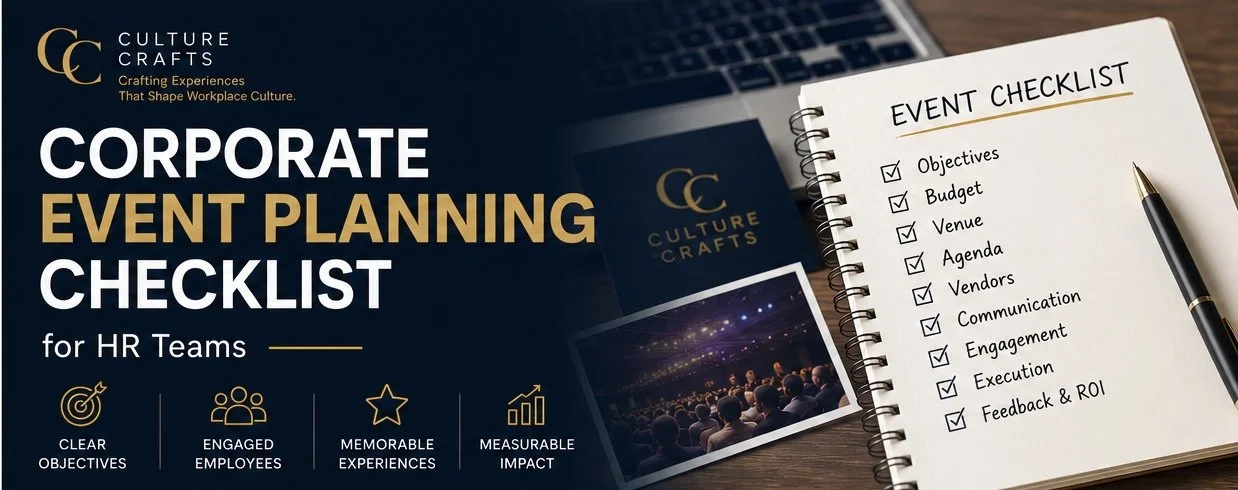
This comprehensive checklist is designed to help HR teams and business leaders confidently plan meaningful workplace experiences—from defining objectives to measuring business impact after the event.
Why Corporate Event Planning Matters More Than Ever
The role of corporate events has evolved significantly over the past few years.
Employees today value experiences that help them feel connected, recognised, and inspired. At the same time, organisations expect every event to support broader business goals such as improving engagement, strengthening culture, increasing collaboration, or enhancing employer branding.
A thoughtfully planned corporate event can help organisations:
Improve employee engagement
Strengthen workplace culture
Encourage cross-functional collaboration
Celebrate milestones and achievements
Reinforce organisational values
Boost employee morale
Improve retention
Build a stronger employer brand
The most successful organisations no longer ask, "Should we organise an event?" They ask, "How can this event create lasting impact?"
The Ultimate Corporate Event Planning Checklist
Instead of approaching event planning as one overwhelming task, divide it into manageable phases. This structured approach helps minimise last-minute surprises while creating a better experience for everyone involved.
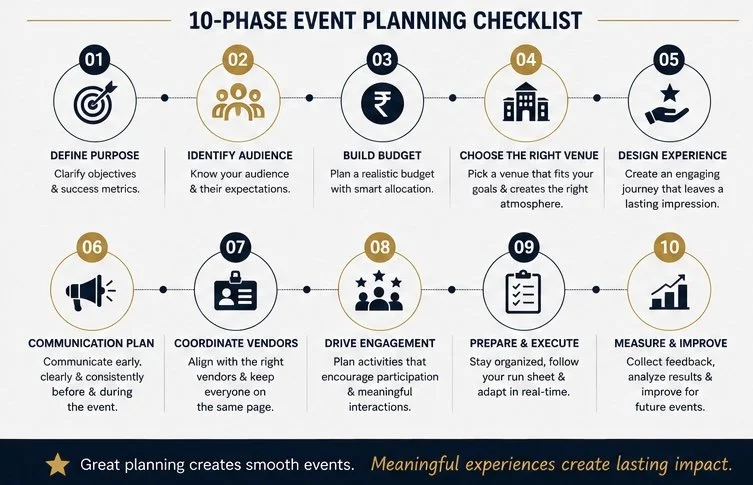
Phase 1: Define the Purpose
Every successful event starts with a clear objective.
Before choosing a venue or discussing themes, ask:
Why are we organising this event?
What business objective does it support?
What should employees take away from this experience?
How will we define success?
Common objectives include:
Employee appreciation
Team building
Leadership communication
Learning and development
Product launches
Company milestone celebrations
Client engagement
Employer branding
A clearly defined purpose guides every decision that follows.
Phase 2: Identify Your Audience
Not every corporate event is designed for the entire organisation.
Understanding your audience helps determine the scale, format, agenda, and overall experience.
Consider whether the event is intended for:
The entire organisation
Leadership teams
Department-specific teams
New employees
Clients and partners
Sales teams
Remote or hybrid employees
Designing an experience around the audience always delivers better results than adopting a one-size-fits-all approach.
Phase 3: Build a Realistic Budget
Budget planning isn't simply about controlling costs—it's about investing where the experience matters most.
Your event budget should account for:
Venue
Food and beverages
Audio-visual setup
Stage and production
Event branding
Décor
Photography and videography
Entertainment
Corporate gifts
Employee engagement activities
Transportation (if required)
Contingency expenses
A contingency allocation of 10–15% is always recommended to manage unexpected requirements.
Phase 4: Choose the Right Venue
The venue plays a crucial role in shaping the overall employee experience.
When evaluating venues, consider:
Accessibility
Parking availability
Public transport connectivity
Seating capacity
Audio-visual infrastructure
Internet connectivity
Power backup
Accessibility for differently abled employees
Accommodation facilities (for offsites)
Emergency preparedness
Rather than choosing the most luxurious venue, choose one that best supports your event objectives.
Phase 5: Design the Employee Experience
This is where memorable corporate events stand apart from ordinary ones.
Employees rarely remember the menu or stage décor.
They remember how the event made them feel.
Map the entire attendee journey:
Registration
Welcome experience
Networking opportunities
Icebreaker activities
Interactive sessions
Recognition moments
Entertainment
Team engagement
Closing ceremony
Takeaway gifts
Post-event communication
Every interaction contributes to the overall experience.
Phase 6: Build a Communication Plan
Strong communication creates excitement long before the event begins.
Your communication plan should include:
Save-the-date announcement
Invitations
Registration reminders
Event agenda
Speaker announcements
Venue details
Dress code
FAQs
Leadership messages
Event countdown
Thank-you communication
Consistent communication significantly improves participation and engagement.
Phase 7: Coordinate Vendors
Behind every successful event is a well-coordinated vendor ecosystem.
Prepare a vendor tracker covering:
Venue
Catering
Production
Audio-visual
Photography
Videography
Entertainment
Printing
Merchandise
Transportation
Event staffing
Assign a single point of contact for each vendor to streamline communication.
Phase 8: Focus on Employee Engagement
Attendance alone doesn't determine success.
Meaningful participation does.
Consider incorporating:
Live polls
Team challenges
Recognition ceremonies
Wellness activities
Networking lounges
Experience zones
Gamification
Interactive workshops
Leadership Q&A sessions
Collaborative activities
Employees should leave feeling involved—not just informed.
Phase 9: Event Day Execution
Create a detailed run sheet covering:
Registration
Technical rehearsals
Vendor arrival
Speaker briefing
Stage management
Volunteer responsibilities
Photography schedule
Emergency contacts
Gift distribution
Backup equipment
A detailed execution plan keeps the event running smoothly, even when unexpected situations arise.
Phase 10: Measure Success
The event doesn't end when the lights go off.
That's when learning begins.
Measure success through:
Attendance rate
Employee participation
Feedback scores
Employee Net Promoter Score (eNPS)
Social media engagement
Leadership feedback
Budget adherence
Achievement of business objectives
Capturing these insights helps improve future events while demonstrating measurable value to leadership.
Common Corporate Event Planning Mistakes
Even experienced HR teams encounter challenges.
Avoid these common mistakes:
Starting planning too late
Skipping objective setting
Prioritising logistics over employee experience
Poor communication
Unrealistic budgeting
Ignoring employee feedback
Overloading the agenda
No contingency planning
Lack of ownership
Failing to measure outcomes
Awareness of these pitfalls helps prevent unnecessary stress and ensures a smoother event experience.
How Culture Crafts Creates Experiences Beyond Events
At Culture Crafts, we believe corporate events should do more than fill calendars—they should shape workplace culture.
While many event agencies focus primarily on logistics and execution, we begin with a different question:
What should people remember after the event is over?
That mindset influences everything we create.
Before recommending a venue, activity, or theme, we take time to understand your organisation's culture, business goals, employee demographics, and the outcomes you want to achieve. Every experience is intentionally designed to encourage connection, strengthen collaboration, celebrate people, and reinforce your company's values.
Whether it's a leadership offsite, annual day, town hall, employee appreciation programme, wellness initiative, experiential brand activation, or team-building event, our approach combines strategic thinking with creative execution.
What Makes Culture Crafts Different?
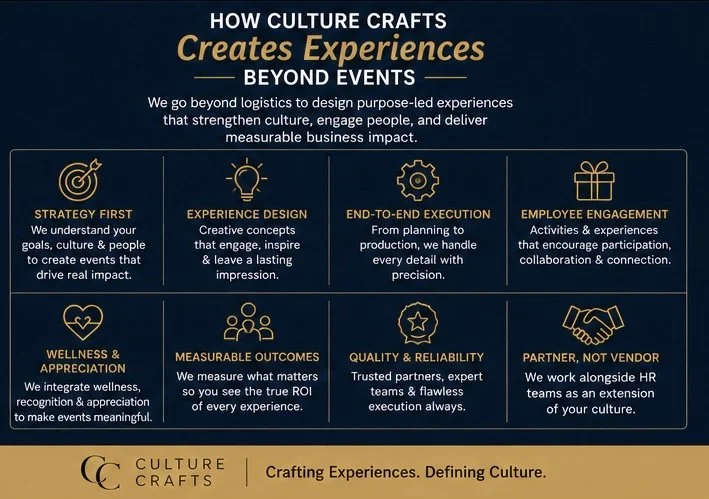
Culture-First Planning – Every event begins with your people, purpose, and organisational goals.
Experience-Led Design – We create immersive experiences that employees genuinely remember.
End-to-End Execution – From ideation and planning to on-ground management and post-event analysis, we manage every detail.
Employee-Centric Approach – Activities are designed to encourage participation, collaboration, and meaningful interactions.
Measurable Outcomes – We help organisations evaluate engagement, participation, feedback, and business impact—not just attendance.
We don't simply organise events.
We craft workplace experiences that inspire people, strengthen culture, and create lasting business value.
Final Thoughts
Great corporate events rarely happen by accident.
They're the result of thoughtful planning, clear objectives, meaningful experiences, and meticulous execution.
The venue, entertainment, and décor may create the first impression—but it's the connections employees build, the recognition they receive, and the memories they take back to work that define a truly successful event.
The next time you're planning a workplace event, don't start with the theme.
Start by asking:
"What experience do we want our people to remember?"
The answer will guide every decision that follows.
Frequently Asked Questions
How far in advance should HR teams start planning a corporate event?
For medium to large corporate events, planning should ideally begin 60–90 days in advance. Leadership offsites, annual days, and conferences may require 3–6 months depending on scale.
What is the most important part of corporate event planning?
Defining clear objectives. A well-defined purpose helps shape the budget, venue, agenda, activities, and success metrics.
How do you measure the success of a corporate event?
Key metrics include attendance, participation rate, employee feedback, eNPS, engagement during activities, social media interaction, and whether the event achieved its intended business objectives.
What should HR teams include in a corporate event budget?
Typical budget heads include venue, catering, production, audio-visual setup, décor, entertainment, branding, photography, employee gifts, transportation, staffing, and contingency expenses.
Why are experiential corporate events becoming popular?
Experiential events encourage employees to actively participate rather than passively attend. They strengthen workplace culture, improve engagement, foster collaboration, and create memorable experiences that leave a lasting impact.
